
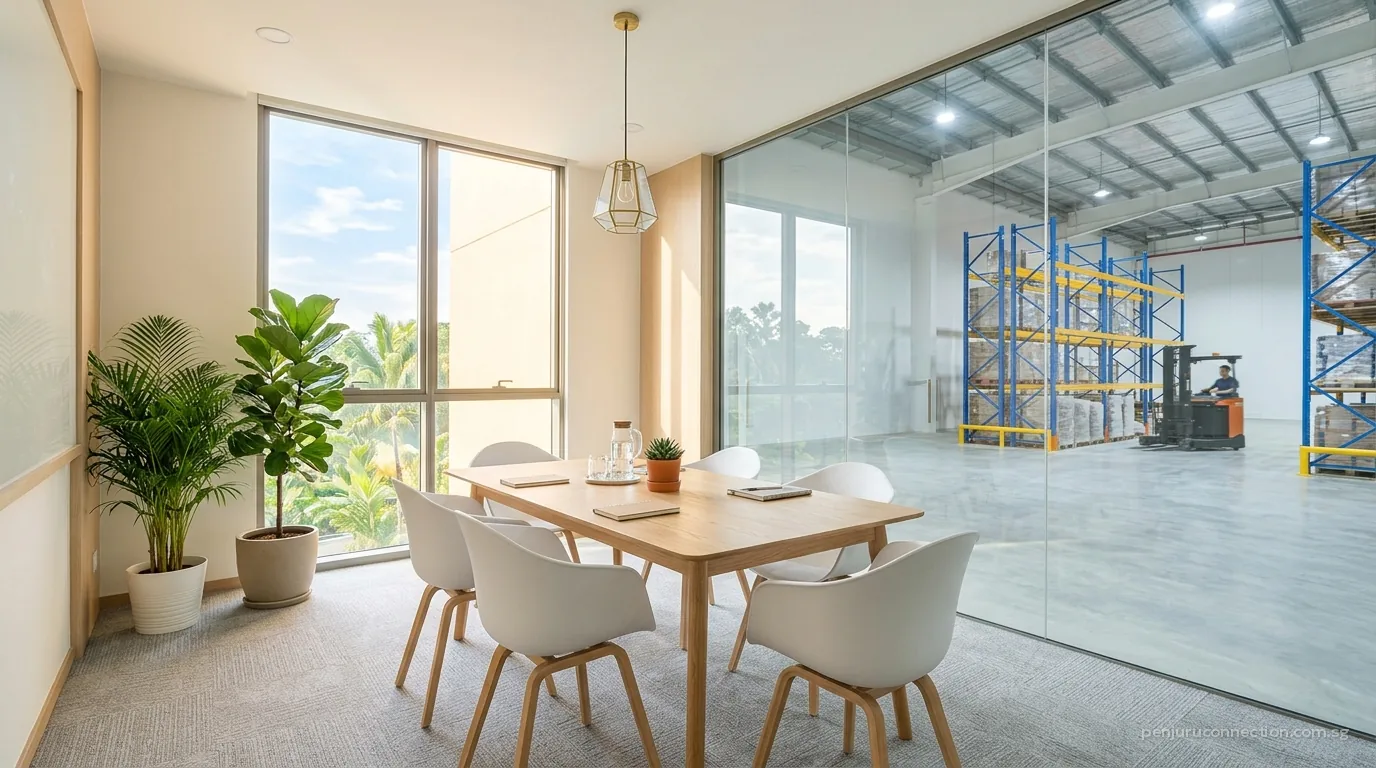
 Artist’s impression · Illustrative only, not the development
A purchase at Penjuru Connection is usually funded with the buyer’s own cash and a commercial property loan from a bank, most often taken in a company’s name. MAS sets no fixed loan-to-value cap for industrial property, so each bank sets its own limit, but on a building under construction the practical maximum at purchase is about 80% because the first 20% is paid before the bank disburses anything.
This guide explains how lenders typically approach B2 industrial units, the role of the payment schedule, how the debt servicing framework applies to individuals and companies, and why CPF is not part of the picture. All figures are indicative, as at October 2026; confirm your own terms with your bank and with MAS guidance.
Loan-to-value for a Penjuru Connection unit
MAS sets no fixed loan-to-value ceiling for industrial and commercial loans, so the amount a bank will lend depends on its own credit policy, the property and the borrower. Lenders generally treat owner-occupiers most favourably, because the loan is supported by a business that will operate from and maintain the premises.
| Situation | Indicative loan-to-value |
|---|---|
| Completed unit, occupied by the purchasing business | Up to about 90% |
| Completed unit, bought to lease out | Up to about 80% |
| Unit bought while the building is under construction | About 80% in practice at purchase |
| Borrower with substantial existing property loans, or a short remaining lease | Lower, at the bank’s discretion |
Indicative ranges only — confirm with your bank / MAS before commitment.
Why the build stage caps lending at Penjuru Connection
Penjuru Connection is a new development on land awarded by JTC on 23 January 2026, so units bought before completion are paid for under the progressive schedule used for commercial and industrial property. The first 20% is due within the first eight weeks after the option is granted: a 5% option fee, then the balance of the downpayment when the sale and purchase agreement is exercised and completed. GST at 9% is added to each instalment where the seller is GST-registered.
The bank releases its loan only for the later stages, as the foundation, structure, walls and other works are certified. That is why a buyer of a unit under construction should plan for at least 20% of the price, plus GST, Buyer’s Stamp Duty and legal costs, from their own funds. The payment scheme page lists every stage, and the purchase calculator shows the cash needed in the first eight weeks on an illustrative figure you can replace with your own.
TDSR, company borrowers and Penjuru Connection
The Total Debt Servicing Ratio framework applies to individual borrowers, including sole proprietors and individuals who set up a company only to buy the property. It caps the share of income that can go to debt repayments. A company that borrows in its own right is assessed differently: the bank looks at the company’s financial statements, cash flow and, often, guarantees from directors or a parent.
Many banks are reluctant to lend to individuals for B1 and B2 industrial units at all and prefer a corporate borrower, so the structure of the purchase is worth settling before the option is signed. CPF savings cannot be used for industrial or commercial property; the purchase is funded by cash and the bank loan.
Loan tenure and the lease at Penjuru Connection
Industrial loans commonly run for up to 25 or 30 years, but the lease matters. Penjuru Connection sits on a 33-year JTC tenure, and lenders usually keep a margin between the end of the loan and the end of the lease, so the tenure offered may be shorter than the maximum on longer-lease property. Interest rates on industrial loans are set by each bank, and the lock-in period, the rate after lock-in and any repricing terms deserve as much attention as the headline rate.
The industrial loan page sets out these points in more detail, and the stamp duty and GST page covers the taxes that sit on top of the loan.
Preparing a financing plan for Penjuru Connection
A practical sequence is to decide which entity will buy, obtain indicative terms from two or three banks, and model the cash needed for the first eight weeks and for GST through construction. Owner-occupiers should also check how the bank treats an operating business that will move in at completion.
The unit sizes, storey count and specification have yet to be published; the developer will release them with the floor plans and the e-brochure, and registered buyers receive them first. Pricing is released by the developer in due course, as noted on the pricing page, so any financing plan built now works on illustrative figures.
Write to the Sales Concierge to receive the sales documents and payment details as soon as they are issued.