
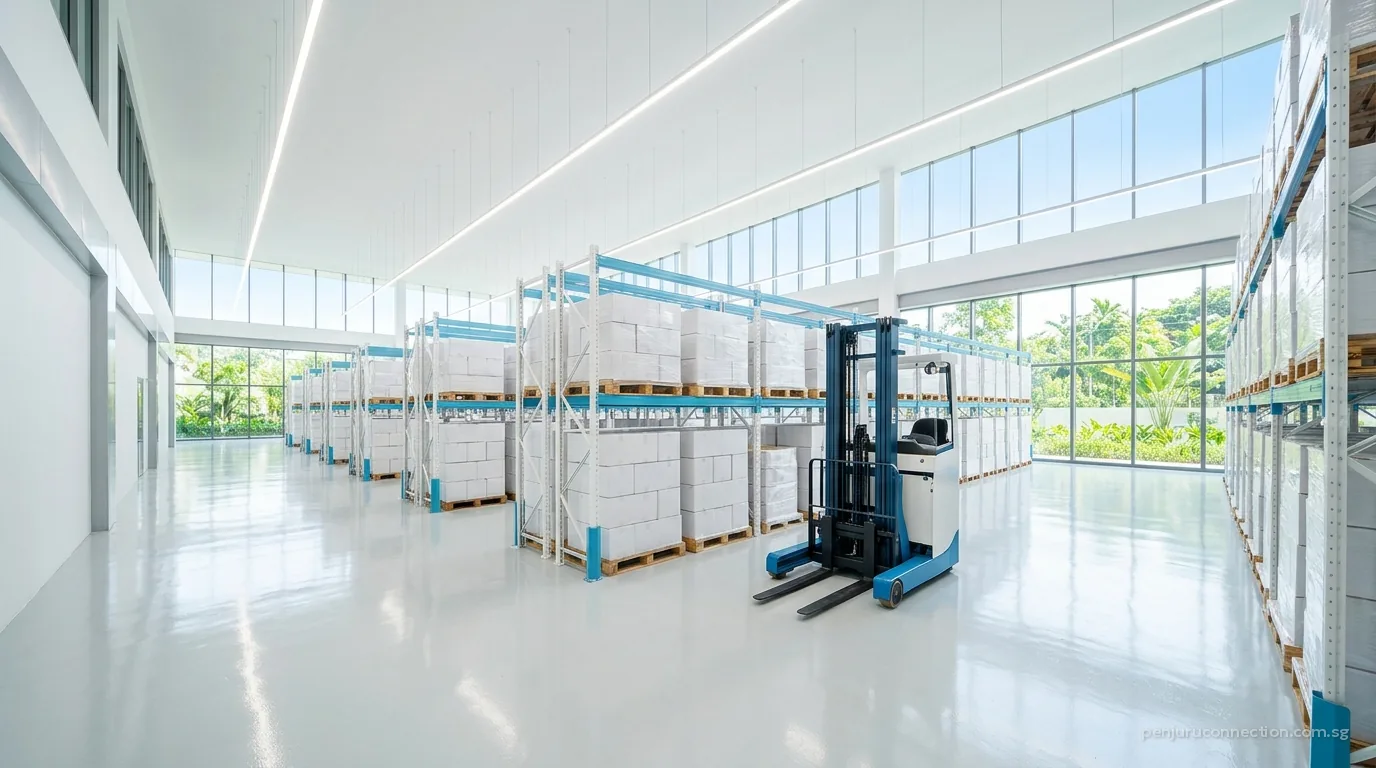
 Artist’s impression · Illustrative only, not the development
Yes. Industrial property such as Penjuru Connection carries no nationality test for ownership, so individuals of any nationality, Singapore-incorporated companies and foreign entities can buy. No Additional Buyer’s Stamp Duty arises on an industrial purchase, whoever the buyer is, as at October 2026.
That openness is one of the reasons B2 space draws regional manufacturers, logistics groups and investors. The practical questions are less about eligibility and more about how the purchase is structured, how it is financed and whether the intended activity fits the approved uses. This article walks through each.
Who can own a unit at Penjuru Connection
Ownership of industrial property in Singapore is open on equal terms. A Singapore citizen, a permanent resident, a foreign individual, a local company or an overseas company can each acquire a B2 strata unit on the same basis.
In practice, most industrial purchases are made through a company rather than in a personal name, because the unit is a business asset and because lenders tend to prefer it. A foreign group setting up in Singapore will often incorporate a local entity first, both for the purchase and for running operations from the premises.
Stamp duty for foreign buyers at Penjuru Connection
Every buyer of a Singapore property pays Buyer’s Stamp Duty. For industrial property such as Penjuru Connection, IRAS applies a five-band scale with marginal rates of 1%, 2%, 3%, 4% and 5%, the top rate covering the portion of value above the fourth band. The scale is identical for local and foreign buyers.
| Duty or tax | Industrial purchase, any buyer |
|---|---|
| Buyer’s Stamp Duty | Payable on the industrial and commercial scale, 1% to 5% by band |
| Additional Buyer’s Stamp Duty | Not chargeable on an industrial purchase |
| GST | 9% where the seller is GST-registered, charged on each instalment |
| Seller’s Stamp Duty on a later sale | 15%, 10% or 5% within years one to three; nil after |
IRAS rates as at October 2026. The full bands and a worked calculation are on the stamp duty and GST page.
The stamp duty calculator applies the bands to any figure you enter, which is the quickest way to see the duty for your own budget.
GST and the foreign company buying at Penjuru Connection
A developer selling new units is normally registered for GST, so 9% is added to the price, and while the building is going up that tax is billed instalment by instalment. Whether the buyer can later claim it back depends on the buyer’s own GST position. The usual guideline is that a trading company already registered for GST may be able to recover the tax as input tax from the first instalment onward. A newly formed or investment-holding company would not usually begin claiming during construction, and may only do so once the property reaches TOP and taxable activity starts, subject to the rules set by IRAS.
Foreign groups should take advice on which entity holds the unit, since the choice affects GST recovery as well as financing and accounts.
Structuring the purchase of a Penjuru Connection unit
Overseas groups usually settle three questions before signing an option. The first is which entity will own the unit: a new Singapore subsidiary, an existing operating company or a holding vehicle. The second is how that entity will be funded, since the downpayment, stamp duty and GST must be paid in Singapore dollars within fixed deadlines. The third is who signs, as the option and the sale and purchase agreement are executed in the buyer’s name and conveyancing lawyers will ask for corporate documents early.
Getting these settled before the developer releases its sales documents keeps the first eight weeks of the payment timeline calm, and it helps banks give indicative financing terms sooner.
Financing a Penjuru Connection unit as a foreign buyer
Banks in Singapore set their own lending policies for industrial property; MAS sets no fixed loan-to-value cap for industrial purchases. Many lenders prefer to lend for B1 and B2 units to a company rather than to an individual, and some decline individual borrowers for this property class altogether. A foreign-owned buyer will usually be assessed on the Singapore entity’s financials, the parent’s support and the intended use.
The industrial loan page explains typical loan-to-value ranges and how a building under construction limits what a bank can disburse in the early weeks. CPF savings cannot be used for industrial property, so the purchase is funded from cash and a bank loan.
Use approvals at Penjuru Connection apply to every owner
Ownership is open, but use is regulated. Penjuru Connection is zoned Business 2, and URA’s guideline requires at least 60% of each strata unit to be used for industrial purposes, with ancillary uses such as an office capped at 40%. A foreign operator moving a process to Singapore should confirm early that it fits the approved uses and any NEA or licensing requirements.
The unit sizes, specification and floor plans will be released by the developer, and registered buyers receive them first. The developer page describes Soilbuild’s business-space track record, and the location page shows how close the site sits to Jurong Port and the Jurong Island Checkpoint.
Overseas buyers and their advisers can write to the Sales Concierge for the sales documents as soon as they are issued.